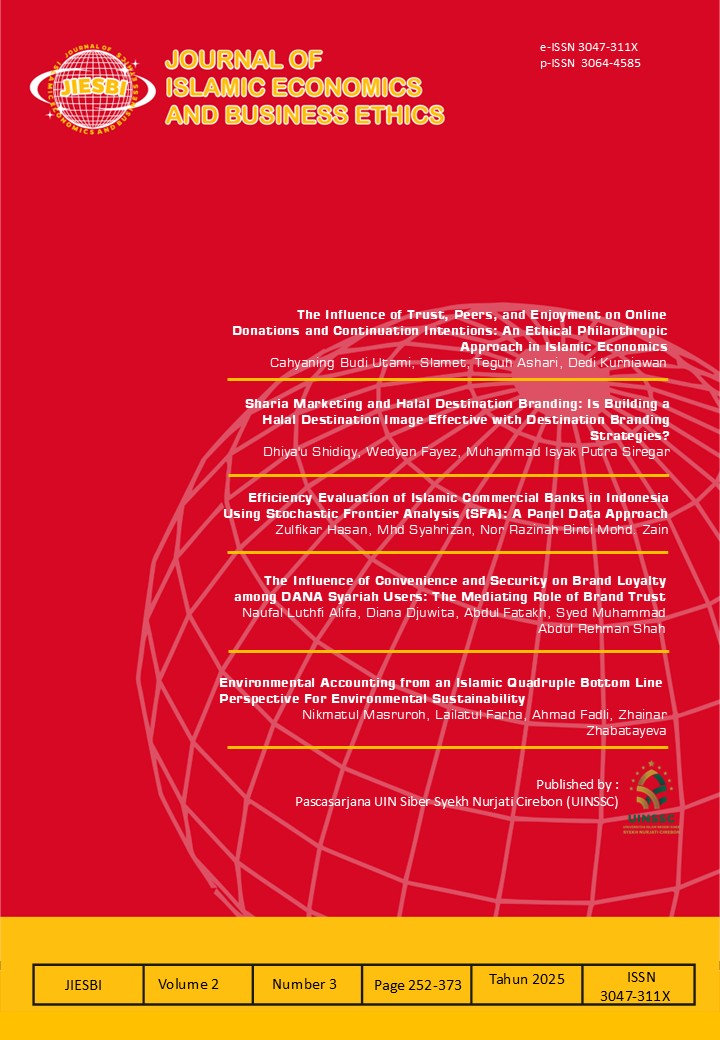
Efficiency Evaluation of Islamic Commercial Banks in Indonesia Using Stochastic Frontier Analysis (SFA): A Panel Data Approach
DOI:
https://doi.org/10.24235/jiesbi.v2i3.436Keywords:
Islamic Banking , Panel Data, Stochastic Frontier Analysis, Technical EfficiencyAbstract
The efficiency of Islamic commercial banks is a crucial determinant of their competitiveness and long-term sustainability, especially in a dynamic financial environment, such as Indonesia. Despite rapid growth in the Islamic banking sector, questions persist regarding whether these banks are operating at optimal efficiency levels. This study aims to evaluate the technical efficiency of Islamic commercial banks in Indonesia over the period 2015–2024 by employing Stochastic Frontier Analysis (SFA) with a translog production function applied to balanced panel data. The model incorporated key input variables, including total assets, labor expenses, and operational costs, with financing used as a proxy for output performance. Empirical findings revealead that an average technical efficiency score of 0.784, suggesting notable inefficiencies across the sector. Among the sampled institutions, BCA Syariah Bank and Mega Syariah Bank consistently outperform their peers, while Victoria Syariah Bank showed persistently low efficiency due to operational shortcomings. The estimated gamma parameter (0.886) further indicated that inefficiency significantly explains the variation in output among banks, validating the use of the SFA model. The study underscores the urgent need for strategic improvements in operational management, resource allocation, and digital transformation initiatives. In addition, regulatory bodies are encouraged to strengthen institutional frameworks and promote innovation and human capital development.
References
Abdalla Ahmed, G. (2023). The implication of using profit and loss sharing modes of finance in the banking system, with a particular reference to the equity participation (partnership) method in Sudan. Humanomics, 24(3), 182–206. https://doi.org/10.1108/08288660810899359
Abedifar, P., & Tarazi, A. Molyneux, P. (2020). Islamic banking and finance: Recent empirical literature and directions for future research. Journal of Economic Surveys, 2507(February), 1–9. https://doi.org/https://doi.org/10.1111/joes.12344
Alqahtani, F., & Mayes, D. G. (2022). Revisiting the efficiency of Islamic banks: Evidence from GCC countries using dynamic network DEA. Global Finance Journal, 33(1), 1–12. https://doi.org/https://doi.org/10.1016/j.gfj.2021.100722
Amalia, R., & Fitrani, E. (2021). The impact of COVID-19 on the performance and risk management of Islamic banks in Indonesia. Pharmacognosy Magazine, 75(17), 399–405.
Bader, M. K. I., Ariff, M., Mohamad, S., & Hassan, T. (2021). Cost, revenue, and profit efficiency of Islamic versus conventional banks: International evidence using data envelopment analysis. Islamic Economic Studies, 49, 69–73. https://www.bertelsmann-stiftung.de/fileadmin/files/BSt/Publikationen/GrauePublikationen/MT_Globalization_Report_2018.pdf%0Ahttp://eprints.lse.ac.uk/43447/1/India_globalisation, society and inequalities(lsero).pdf%0Ahttps://www.quora.com/What-is-the
Battese, G. E., & Coelli, T. J. (1995). A model for technical inefficiency effects in a stochastic frontier production function for panel data. Empirical Economics, 120(11), 259.
Chong, J., Sin, C., & Kathiarayan, V. (2023). Leveraging emotional intelligence in leadership: Exploring the impact on organizational performance and employee engagement 1. International Journal of Management and Commerce Innovations, 11(1), 53–61. https://doi.org/10.5281/zenodo.7919454
Dahlan, R., Susanto, E., Fauzi, A., & Fauzi, M. (2025). Is the continuity of Islamic banking usage related to customer religiosity?. JIESBI: Journal of Islamic Economics and Business Ethics, 2(2), 170–197. https://doi.org/10.24235/jiesbiv1i3
Fauzi, I., Firmansyah, I., & Nasution, A. D. (2021). Comparative efficiency analysis of Islamic and conventional banks in Indonesia: A stochastic frontier approach. Jurnal Keuangan Dan Perbankan, 75(17), 399–405.
Fauzi, I., & Nasution, A. DFirmansyah, I. (2021). Comparative efficiency analysis of Islamic and conventional banks in Indonesia: A stochastic frontier approach. Jurnal Keuangan Dan Perbankan, 75(17), 399–405.
Giri, A. K., Mohapatra, G., & Debata, B. (2021). Technological development, financial development, and economic growth in India: Is there a non-linear and asymmetric relationship?. Journal of Economic and Administrative Sciences, 8–10. https://doi.org/10.1108/jeas-03-2021-0060
Hasan, Z. (2022). The effect of CAR, ROA, NPF, and BOPO on net operating margin ( NOM ) in Indonesian shariah banking. Annual Conference of Ihtifaz: Islamic Economics, Finance, and Banking, 2(June), 41–60.
Hasan, Z., & Sari, D. P. (2020). Technical efficiency of Islamic commercial banks in Indonesia: A stochastic frontier analysis. Indonesian Journal of Islamic Economics, 1–9.
Hosen, M. N., & Muhari, S. (2021). Efficiency of Islamic banks in Indonesia: A panel regression approach. Buletin Ekonomi Moneter Dan Perbankan, 26(4), 1–37.
Khurshid, R., Naeem, H., Ejaz, S., Mukhtar, F., & Batool, T. (2023). Service quality and customer satisfaction: An empirical study. International Journal of Economics and Management Sciences, 1(9), 24–30.
Kondapaka, K. K. (2023). Implementing AI-driven chatbots for customer service in financial institutions : Performance and user experience. Hong Kong Journal of AI and Medicine, 3(1), 363–401.
Kumbhakar, S. C., & Lovell, C. A. K. (2023). Stochastic frontier analysis.
Mahdi Igamo, A., & Aulia Falianty, T. (2021). Sriwijaya international journal of dynamic economics and business: The impact of electronic money on the efficiency of the payment system and the substitution of cash in Indonesia. Sijdeb, 2(3), 237–254. http://ejournal.unsri.ac.id/index.php/sijdeb
Mansur, R., & Rahayu, S. (2021). The effect of capital adequacy and non-performing financing on Islamic banks’ efficiency in Indonesia. Journal of Islamic Financial Studies, 75(17), 399–405.
Mohamad, S., & Mohd Noor, N. A. (2021). Efficiency of Islamic banks in Malaysia: A stochastic frontier approach. Journal of Islamic Accounting and Business Research, 3, 32.
Pambudi, S. A., & Mubin, M. K. (2023). Analysis: The effect of electronic money use on velocity of money: Evidence from Indonesia. Jurnal Ilmu Ekonomi Terapan, 5(1), 42. https://doi.org/10.20473/jiet.v5i1.19626
Prima Sakti, M. R., & Mohamad, A. (2021). Efficiency, stability, and asset quality of Islamic vis-à-vis conventional banks: Evidence from Indonesia. Journal of Islamic Accounting and Business Research, 9(3), 378–400. https://doi.org/10.1108/JIABR-07-2015-0031
Puneri, A., Chora, M., Ilhamiddin, N., & Benraheem, H. (2022). The disclosure of Sharia non-compliance income: Comparative study between full-fledged and subsidiary Malaysian Islamic banks. JESI (Jurnal Ekonomi Syariah Indonesia), 9(2), 104. https://doi.org/10.21927/jesi.2019.9(2).104-117
Putri, D. A., & Kurniawan, I. (2021). (2021). Liquidity risk and bank stability of Islamic banks in Indonesia amid the COVID-19 pandemic. Journal of Islamic Finance, 75(17), 399–405.
Ros Aniza, M. S., & Abdul Rahman, A. R. (2021). An exploratory study of ijarah accounting practices in Malaysian financial institutions. PDF created with finePrint pdf factory pro trial version www.pdffactory.com PDF created with FinePrint pdfFactory Pro trial version www.pdffactory.com. International Journal of Islamic Financial Services, 5(3), 1–15.
Rosman, R., Wahab, N. A., & Zainol, Z. (2021a). Efficiency of Islamic banks: A review of literature and directions for future research. Journal of Islamic Accounting and Business Research, 75(17), 399–405. https://doi.org/https://doi.org/10.1177/2158244020914634
Rosman, R., Wahab, N. A., & Zainol, Z. (2021b). Efficiency of Islamic banks during the financial crisis: An analysis using DEA and SFA. The Developing Economies, 1(22 Jan), 1–17.
Rosman, R., & Zainol, ZWahab, N. A. (2020). Efficiency of Islamic banks: A review of literature and directions for future research. Journal of Islamic Accounting and Business Research, 1(22 Jan), 1–17. https://doi.org/https://doi.org/10.1108/JIABR-10-2012-0064
Rusydiana, A. S., Rahmawati, R., & Shafitranata, S. (2021). DEA on Islamic banking: A bibliometric study and critical perspective. Library Philosophy and Practice, May.
Santoso, W. (2021). Government support and Islamic banking performance in Indonesia: Evidence from panel data. International Journal of Islamic and Middle Eastern Finance and Management, 75(17), 399–405. https://doi.org/https://doi.org/10.1108/IMEFM-09-2020-0460
Savitri, M., & Armando, D. Y. (2022). A survey on the community satisfaction index based on kepmenpan No. 25/M.Pan/2/2004 At Kanujoso Djatiwibowo Regional General Hospital, Balikpapan, in 2018. Journal of Indonesian Health Policy and Administration, 4(1), 22–26. https://doi.org/10.7454/ihpa.v4i1.2855
Sonmez Cakir, F., & Adiguzel, Z. (2021). Analysis of leader effectiveness in organization and knowledge sharing behavior on employees and organization. SAGE Open, 10(1). https://doi.org/10.1177/2158244020914634
Sudiro, B. A., Ahmar, N., & Ardiansyah. (2022). Murabahah financing, musyarakah, mudharabah, istishna, and ijarah against Sharia banking profit sharing. JFBA: Journal of Financial and Behavioural Accounting, 2(2), 40–49. https://doi.org/10.33830/jfba.v2i2.4182.2022
Sufian, F. (2021). The efficiency of the Islamic banking industry in Malaysia: Foreign vs domestic banks. Humanomics, 7(3), 213–221.
Suhendar, S., & Hidayat, T. (2021). Efficiency and productivity of Indonesian Islamic banks: A stochastic frontier analysis. International Journal of Islamic and Middle Eastern Finance and Management, 11(1), 92–105.
Tatineni, S., & Mustyala, A. (2024). Enhancing financial Security: Data science’s role in risk management and fraud detection. International Journal of Advancements in Computational Technology, 2(2), 2583–8628. https://doi.org/10.56472/25838628/IJACT-V2I2P113
Taufiq, M., & Wahyuni, S. (2022). The role of Sharia governance in improving Indonesian Islamic banks’ performance. Journal of Islamic Banking and Finance, 33(1), 1–12.
Usman, H., Mulia, D., Chairy, C., & Widowati, N. (2022). Integrating trust, religiosity, and image into the technology acceptance model: The case of the Islamic philanthropy in Indonesia. Journal of Islamic Marketing, 13(2), 381–409. https://doi.org/10.1108/JIMA-01-2020-0020
Downloads
Published
Issue
Section
License
Copyright (c) 2025 Journal of lslamic Economics and Bussines Ethics

This work is licensed under a Creative Commons Attribution 4.0 International License.
Authors retain copyright and grant the journal right of first publication with the work simultaneously licensed under a Creative Commons Attribution 4.0 International License that allows others to share the work with an acknowledgement of the work's authorship and initial publication in this journal.
Authors are able to enter into separate, additional contractual arrangements for the non-exclusive distribution of the journal's published version of the work (e.g., post it to an institutional repository or publish it in a book), with an acknowledgement of its initial publication in this journal.
Authors are permitted and encouraged to post their work online (e.g., in institutional repositories or on their website) prior to and during the submission process, as it can lead to productive exchanges, as well as earlier and greater citation of published work (See The Effect of Open Access).